Insights to build a more profitable business
How Capline is Moving eCommerce Forward
What Capline is all about, bringing together speed and strategy to help our customers keep up in modern e-Commerce marketplaces.
E-commerce marketplaces today move at breakneck speed. Prices shift by the hour, ad auctions update every few minutes, competitors appear overnight, and inventory can be burned in days. In this world, decision-making is constant. If you can’t make smart, financially sound decisions quickly and at scale, you’ll either get steamrolled by your competition or burn cash until you run out of business runway.
That reality is exactly why we started this company. Most brands are stuck with dashboards that lag behind the action or black-box automation that ignores business nuance. What’s needed is something different: systems that move as fast as the marketplace while keeping strategy firmly in human hands.
Our Background: Lessons Learned From the Marketplace Frontlines
Our team first came together at Wayfair where we built and scaled systems core to the operations of a massive multi-category marketplace. Building systems to work across tens of millions of products taught us hard won lessons in scaling decision making and making use of cutting edge data science to inform e-Commerce operations.
Later, at Thrasio, a >$1B+ annual Amazon seller, we helped reshape how decisions were made across a portfolio of thousands of products during a time of intense financial strain. This taught us the criticality of tying strategy to the P&L, ensuring that decisions could be made quickly without risking the stability of the balance sheet.
Through this journey, we came to one simple realization: marketplaces reward speed, but businesses succeed on strategy. The tools we wished we had then are exactly what we’re building today.
How We Solve This: Three Pillars
1. Advanced Measurement & Machine Learning
Every decision begins with measurement. But in e-commerce, most measurements are too blunt, averages, rollups, or lagging KPIs that miss what’s really happening every time a customer interacts with your products. Acting on that kind of data is like navigating a storm with yesterday’s weather report.
What we build instead are causal measurement systems enhanced by machine learning. Using double machine learning, we measure at a highly granular level, separating correlation from causation: not just what happened, but why it happened.
And critically, these measurements aren’t static. They’re constantly refreshing in a continuous improvement loop, learning from data on >$1.4B in annualized sales across our customer base. The system tests, learns, and recalibrates in near real-time until it zeroes in on what really works for each of your products. Over time, this builds a living model of your business that gets sharper and more adaptive the longer you use it.
2. Financial & Joint Optimization
Measurement is only valuable if you can act on it with clear financial context. Small missteps in pricing, ads, or inventory can ripple into massive P&L consequences.
That’s why we anchor all our decisions in P&L-based financial optimization. Instead of optimizing proxy metrics like impressions or ROAS, we evaluate financial trade-offs explicitly. Want to grow top-line revenue by cutting prices? We’ll quantify, upfront, the cost: e.g., “10% revenue lift, $500K profit impact over the next month.” That clarity lets you decide whether it’s worth it.
From there, we go one step further: joint optimization. You can’t optimize in silos. Decisions about pricing affect ads, ads affect inventory, inventory affects promotions, and so on. Our systems account for the interdependence across these levers, whether you want to grow a product through lower prices, stronger ad spend, or a coordinated mix of both.
3. Strategic Control
While algorithms move fast, strategy is human. The way we bridge those worlds is a two-step process:
- Segment your products. Not every product plays the same role or is in the same stage in its lifecycle. Some are new introductions looking to gain traction, others are profit centers looking to expand margins, others are overstocked at the end of their lifecycle. We help you categorize your catalog into strategic segments that reflect your real business objectives.
- Define strategies. Within each segment, you then set the strategic dials, growth vs. profit, market share vs. margin, and let the system translate those into consistent tactical decisions across pricing, marketing, promotions, and inventory.
But this isn’t just a set and forget exercise, it’s the beginning of a real-time feedback loop. As the market shifts, competitors drop prices, ads get more expensive, or a product starts to overperform, the system responds minute by minute to stay on track. And you see it all in clear reporting, letting you understand not just what the system is doing, but why, and how it maps back to your objectives.
In short: you choose the strategy, the system runs the playbook, and real-time analytics keep you in the driver’s seat.
Why We’re Here
E-commerce isn’t slowing down, it’s accelerating. Success depends on moving faster than the market without losing sight of the bigger picture. That’s why we’re building systems that learn continuously, optimize financial outcomes jointly, and give humans the controls they need to steer strategy.
Your vision still sets the direction, while our systems scan the seas and adjust course in real time to keep you safe from the hidden shoals of modern e-commerce.
Let’s Talk
If this resonates with you, if you’ve felt the pain of dashboards that lag behind or automation that ignores nuance, then let’s talk. We’d love to hear your story, share more about ours, and see if we can help light the way.

All articles
The 59% Difference: How Fulfillment Choice Impacts Amazon Success
We used data to put numbers to a classic question.
Context
A client recently asked us about a fundamental choice all sellers face on Amazon: how to fulfill orders.
The primary options are Fulfillment by Amazon (FBA), Fulfillment by Merchant (FBM), or Seller Fulfilled Prime (SFP). FBA provides a coveted Prime badge, but comes with more Amazon fees. FBM promises autonomy, but sacrifices the Prime badge and can negatively impact conversion due to longer delivery speeds. SFP seems to offer a compromise between the two, but qualifying and staying compliant isn’t easy.
But how impactful is the FBA Prime badge? And is SFP actually a happy middleground? Does the right answer vary for different sellers? We dug into our ~$3B data set to settle it once and for all.
We analyzed our ~$3B dataset to settle it once and for all.
What the Data Says
Our analysis of marketplace performance demonstrates a clear hierarchy in fulfillment effectiveness. FBA delivers a 59% sales lift compared to similar products sold through FBM. This advantage stems from several factors: Prime badge visibility, customer confidence in Amazon's fulfillment guarantee and improved Buy Box competitiveness (where relevant).

SFP delivers a 9% lift over FBM, which may seem reasonable until operational requirements come into focus. Maintaining SFP eligibility demands strict performance standards: 93.5% on-time delivery, near-perfect tracking accuracy, and weekend fulfillment capabilities. Few sellers successfully can sustain this performance level at scale.
Implications
- For most sellers, FBA justifies its cost structure through improved conversion rates and Buy Box win frequency. The 59% demand increase typically overcomes fulfillment expenses and generates superior profitability even after accounting for all fees.
- SFP remains impractical for the majority of sellers. The operational investment required to maintain qualification standards typically yields returns that do not justify the complexity. There are of course exceptions to this and to those sellers, we give huge kudos.
- FBM retains value in specific scenarios: when multi-channel pooling and for oversized items, extremely low-margin products, or inventory with minimal velocity. For general merchandise, however, the sales volume reduction can create an unfavorable economic equation.
Interested in How This Might Apply to Your Situation?
Capline works with sellers to evaluate these trade-offs like these and structure fulfillment strategies that maximize profit. To discuss your specific opportunity, contact us at learnmore@capline.com or use the link below.

Joint Optimization: The E-Commerce Lever Your Competitors Haven’t Pulled (Yet)
An introduction to a core Capline topic: Joint Optimization of Demand & Supply Levers in eCommerce.
Most e-commerce leaders pride themselves on running a smooth operation, until a big promotion leaves shelves empty, or they uncover that a surge in ad spend is actually losing money once product-level pricing and margins are factored in. What if you could stop these costly surprises and make every marketing dollar, discount, and inventory move work in perfect harmony?
With pandemic-fueled growth in the rear view, today’s market demands more focus and sharper decisions to truly thrive. Imagine shifting from constant firefighting to a business where each investment in demand is seamlessly tied to your inventory, logistics, and bottom line. That’s the transformative promise of joint optimization: a smarter, unified way to unlock real profit and put your brand ahead of the pack.
What Is Joint Optimization?
Joint optimization is the process of systematically linking all the big levers that drive e-commerce demand (pricing, discounting, promotions, and marketing spend) with the critical decisions that govern your supply chain. It’s about more than just data: it’s the discipline of using real numbers and advanced modeling to connect how you generate sales with how you fulfill them, so every decision is part of a coordinated, profit-focused plan.
Think of joint optimization as an always-on, always-learning “central nervous system” for your e-commerce business. Instead of making pricing, advertisement, and inventory decisions separately, or by instinct, everything feeds into a unified strategy designed to meet your actual financial goals.
Real-World Examples: When Supply Meets Demand
Let’s ground this in a pair of real-world scenarios:
Scenario 1: The Fashion Flash Sale: Imagine a leading apparel brand gearing up for a sitewide summer promotion. Discounting drives a huge spike in sales, but because the supply chain team wasn’t looped in, certain SKUs sold out in hours while others languished in storage. Out-of-stocks hurt customer trust (and future demand), while overstocked items tie up cash and rack up warehouse fees. With joint optimization, you’d have forecasted the lift in demand for each SKU, dynamically set promotional prices and discount depths based on likely margin return, and positioned inventory before the campaign launched, avoiding the chaos entirely.
Scenario 2: Beauty Brand Bid Wars: A top skincare startup wants to double down on paid search ads during a major product launch. The marketing team is ready, but pricing and margin information isn’t considered, and inventory is sitting unevenly across regions. They increase ad spend, only to find that some advertising is now driving unprofitable sales, while some warehouses can’t keep up, resulting in costly expedited shipping or lost orders. With joint optimization, the media mix, pricing, and inventory allocation would all be part of a single, real-time optimization engine: every dollar of ad spend calibrated against real margins, each unit of inventory placed where it will drive the most profitable conversion.
Why Is Joint Optimization So Important?
When e-commerce organizations separate their demand-driving activities from one another and supply chain operations, the result is organizational whiplash: disconnected metrics, missed forecasts, and ad-hoc troubleshooting. It feels a bit like driving a high-performance car without anyone monitoring the fuel or brakes: you can accelerate, but have no control over where you’ll end up.
Some classic pain points without joint optimization:
- Lower your price and suddenly your ads are no longer profitable at the same bid levels
- Raise prices to preserve margin, but don’t update your ad strategy, and your sales tank
- Launch a big promotion, but run out of inventory and leave money on the table
- Cut ad spend to save cash, only to find yourself stuck with excess stock for months
With joint optimization:
- Every lever (price, promotion, ad spend, inventory) works together. Decisions are made with the entire system in mind
- You set high-level financial targets, and the optimization engine works backward to find the best combination of levers to hit them
- Humans remain in the loop, examining where the real world diverges from predictions, making adjustments, and retraining the models so the system gets better over time
- Your team spends less time battling fires and more time thinking strategically about growth
Why Is Joint Optimization Hard?
Despite the common-sense logic behind joint optimization, building these systems is hard (really hard!). Most brands still:
- Make isolated decisions, like setting ad bids without considering recent price changes or true product margins
- Lean on standalone SaaS solutions that optimize one area well (media buying, pricing tools, inventory), but don’t communicate, creating a patchwork of disconnected data
- Resort to trial-and-error, tweaking investments and hoping to see it reflected in topline growth
- Or, most dangerously, set their strategies on autopilot: leaving the same price, ad bids, or forecast for too long, assuming stability, while market dynamics shift under their feet.
Establishing joint optimization demands:
- Clean, structured data that connects demand and supply sides; no easy feat if your tech stack is fragmented
- Advanced modeling to measure the impact of every lever on both sales and margin, using techniques like causal inference and robust machine learning
- Production-grade engineering to ensure recommendations flow seamlessly into decision-making
- Elegant controls that allow financial and strategic leaders to guide the system, not just technologists and data scientists
- Relentless analysis to distinguish signal from noise so you don’t chase every fluctuation, but do spot systemic issues early.
And if your brand is seeing rapid growth? Be wary: growth can mask deep inefficiencies. Think of Toyota’s kaizen philosophy: when you remove excess inventory (your growth cushion), real production problems surface and you can finally fix root causes.
Why Capline?
Capline was built from the ground up for the joint optimization challenge. Our founders and operators have lived these pain points, lost sleep over them, and built the tech and talent to solve them.
- We deploy the most advanced data science measurements we’ve seen in the wild, down to specific causal inference and double machine learning frameworks that accurately attribute the bottom-line impact of each lever.
- Our proprietary tech stack comes with a production-proven optimization engine ready to deploy; no need for months of hand-coding or duct tape integration.
- Our expert operators aren’t just mathematicians or marketers: they’re true business partners, working side by side with your leadership to diagnose issues, oversee system performance, and make hands-on adjustments to meet your real financial goals.
The results? Brands that embrace joint optimization with Lighthouse regularly see 30% or more growth in both sales and profit, sometimes within weeks. If your organization isn’t running joint optimization today, you’re not just missing upside, you’re likely ceding critical ground to savvier competitors.
Ready for a smarter, more unified way to run e-commerce? Let’s talk. Don’t let complexity hold your brand back. And don’t wait until your business hits a wall, or until supply chain chaos and missed forecasts force a change. Joint optimization is challenging, but with the right partner, it’s the most rewarding leap your organization can make.

Keeping Business Hours: Why Amazon Business Customers Require Dynamic Targeting
Should you spend time treating Amazon business customers differently from non business customers?
Context
Amazon continues to roll out new ways to separate business buyers from regular shoppers. The latest: dedicated B2B campaigns that exclusively target Amazon Business customers. But before you spend the time diving into another complex feature, you're probably wondering: Is this actually worth the effort? How differently do these business buyers really behave?
We dug into the data to find out.
What the Data Says
According to our $3.1B dataset, the split is dramatic, starting with daily habits.
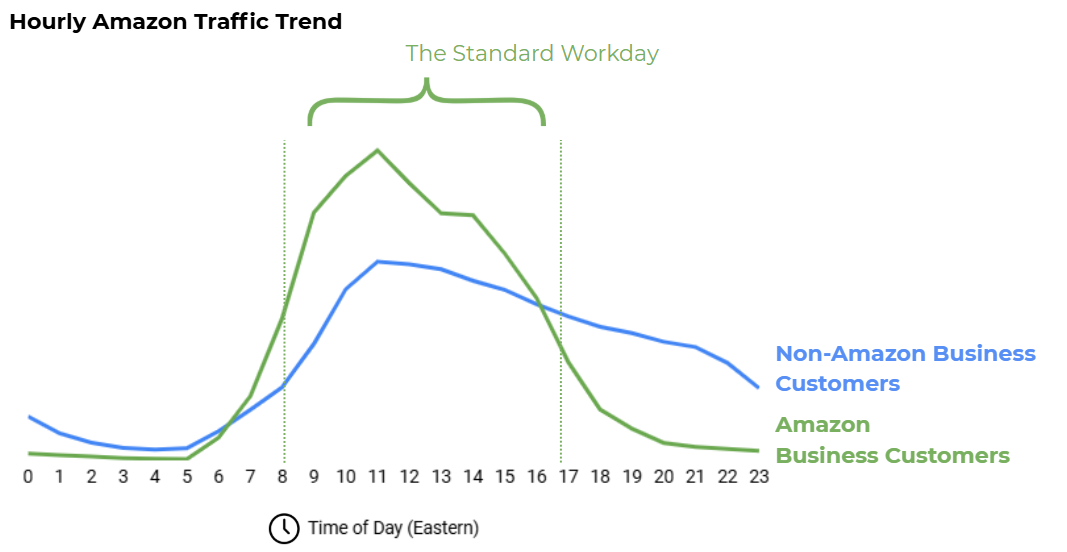
Unsurprisingly, B2B customers concentrate their shopping during business hours (9AM-5PM), with peak activity hitting right before lunch. After 5PM, both traffic and conversions drop over 40%.
Meanwhile, regular consumers maintain much steadier activity throughout the day and well into the evening.
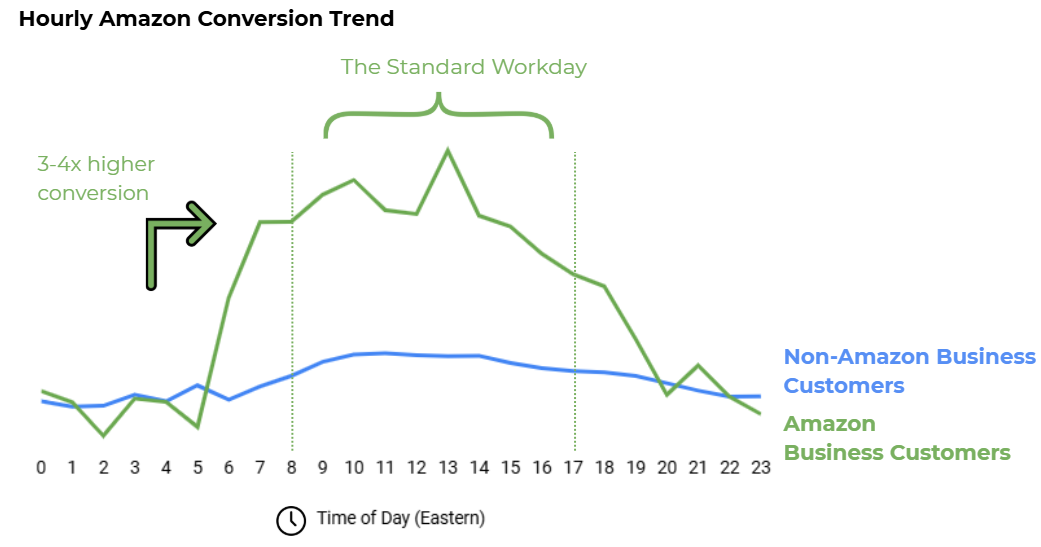
Furthermore, not only does conversion activity mirror this trend, but it shows that B2B customers convert nearly 3-4x higher at peak times.
Implications
Our data makes clear just how much more valuable Amazon Business customers are and how differently they behave. This makes business campaign functionality an indispensable tool, helping sellers avoid the trap of averages and differentiate between these two heterogeneous cohorts.
To take full advantage, sellers must target with granularity:
- Adjust bids to reflect just how much more valuable these customers are.
- Ramp up bids when decision-makers are active.
- Scale back after the workday automatically.
Dynamic bid adjustments that account for profit opportunities, hourly patterns, and day-of-week variations will be key to maximizing this feature’s potential.
Get In Touch
If you’re curious about how Capline can maximize profitability by taking full advantage of the granularity B2B campaigns allow, contact us!
Why eCommerce Sellers Need an Edge Now More Than Ever
An edge isn't just nice to have anymore, it's the price of admission.
Before you roll your eyes at yet another "AI will save ecommerce" take - I get it. Everyone's talking about AI being essential for eCommerce. But after implementing data science-driven systems at eCommerce giants for a combined 75 years, this isn’t another blog post encouraging you to get swept up in the hype. It’s about why now is the time to use new tools to better implement the basics. Let’s get to it:
Back in 2016, I landed at Wayfair as the company was solidly in its golden era. Though the time was not without its issues, the numbers were intoxicating: 50%, 60%+ growth rates quarter after quarter. Then, during the pandemic, growth exploded. Those were the days when ecommerce felt unstoppable.
Today, that broader eCommerce euphoria has faded, replaced by a grinding reality that's forcing online sellers to confront an uncomfortable truth: the easy money is gone, and what's left requires a level of sophistication most businesses simply don't yet have.
The Great Slowdown

The data tells a story that anyone who operates a consumer brand online lives and feels every day. U.S. ecommerce growth, which was growing at a clip of ~14-15% and then peaked at dramatically higher than that in 2020, has plummeted to the single digits, and just 5.3% in the second quarter of 2025. That's the slowest growth rate since late 2022. For context, this means ecommerce is now growing only slightly faster than traditional retail sales.
The implication? The rising tide that previously lifted all boats now presents closer to a zero sum growth game.
The Path to Success is Increasingly Narrow
Amazon has built a marketplace offering sellers extensive capabilities, but these tools come with costs that have steadily increased over time. For example, while referral fees (the percentage commission on each sale) have stayed largely consistent, FBA fulfillment fees have risen nearly twofold for standard-size items since 2021. In response, more than 64% of sellers told SmartScout in a survey that they adapted by raising prices in 2024, keeping pace in a dynamic environment where total fees now often exceed half of gross revenues.
So, to become and stay profitable against this backdrop, sellers must manage inventory, advertising optimization, pricing strategy, compliance monitoring, and customer service, often simultaneously across hundreds or thousands of products.
The Technology Imperative
This brings us to the most critical shift happening right now: data science and artificial intelligence have moved from competitive advantage to operational necessity. According to a 2024 survey by Precedence Research, the global AI in eCommerce market is projected to grow from ~$7 billion in 2024 to ~$64 billion by 2034, a 24% annual growth rate that signals not an emerging opportunity but an existential requirement.
Leading retailers are automating customer service, personalizing product recommendations, and even generating SEO-optimized content at scale.
AI and ML can now be used to predict demand with unprecedented accuracy, optimize pricing in real-time, and manage inventory across complex supply chains. For sellers still relying on manual processes and intuition, this isn't just a disadvantage, it's a death sentence in slow motion.
Businesses must adapt. Those who survived the initial post-pandemic slowdown now find themselves in a permanently more demanding competitive environment where success requires capabilities they've never had to develop.
The Time is Now: A New Competitive Tier Emerges
For online sellers, especially those operating on Amazon, the message is clear: the window for building competitive advantages through advanced technology and operational excellence is open.
And here’s a prediction: What makes this moment so critical is that we will witness the emergence of a new competitive tier in ecommerce. The businesses that invest now in AI-driven automation, sophisticated analytics, and integrated operational systems will pull away from the pack. Meanwhile, those still operating with legacy approaches (manual bid management, spreadsheet-based inventory planning, intuitive pricing strategies) will be systematically squeezed out.
How Capline Changes the Game for Online Sellers
We are offering a different path.
While most sellers are still wrestling with disconnected tools and manual processes, Capline operates fundamentally differently. Instead of using separate systems for pricing, advertising, inventory, and forecasting, each making decisions in isolation, our platform treats these as interconnected pieces of a single puzzle - what we can “joint optimization”. When inventory runs low on a top-performing product, we don’t just send an alert; we automatically adjust advertising spend to preserve margin, update pricing to reflect scarcity, and recalibrate forecasts based on real-time demand signals. When a competitor drops their price, we don't just match it blindly; our platform evaluates the profit impact, considers your current inventory levels, adjusts ad bids accordingly, and determines whether to compete on price or shift budget to higher-margin products. This is what "joint optimization" actually looks like in practice: one brain managing all the levers simultaneously, making thousands of coordinated decisions that manual processes simply cannot match.
We are reimagining how ecommerce operations work in an environment where manual processes have become a liability. The successful sellers of 2030 will look nothing like the successful sellers of 2020, and that transformation is already underway.
Closing
The golden age of rising eCommerce tides is over. What's emerging in its place demands more sophistication, data and technology than ever before. An edge isn't just nice to have anymore, it's the price of admission.
Driving Profitability at Scale: Transforming Amazon Ads for a Fortune 200 Retailer
See how Capline helped a fortune 200 retailer increase profit by 17% while spending 61% less on Amazon ads.
For retailers selling on Amazon, profitable growth can feel like a paradox. Push too hard on advertising, and margins vanish. Pull back, and growth stalls. That was the challenge facing a Fortune 200 retailer with tens of thousands of products on Amazon, and the reason they turned to Capline.
The Situation: Fast Growth, Inefficient Ads
This retailer was expanding quickly but hitting a common wall:
- Inefficient Spend – Their agency was overspending without generating profitable returns.
- Incomplete Coverage – Only 24% of ASIN revenue was supported by ads, leaving massive revenue opportunities untapped.
- Slim Margins – Many products were being promoted at a loss due to lack of cost and margin sensitivity.
With 28,000 products across 817 brands, they needed a more scalable, precise solution than what traditional agencies or bidding tools could provide.
The Capline Solution: Profit-First Optimization
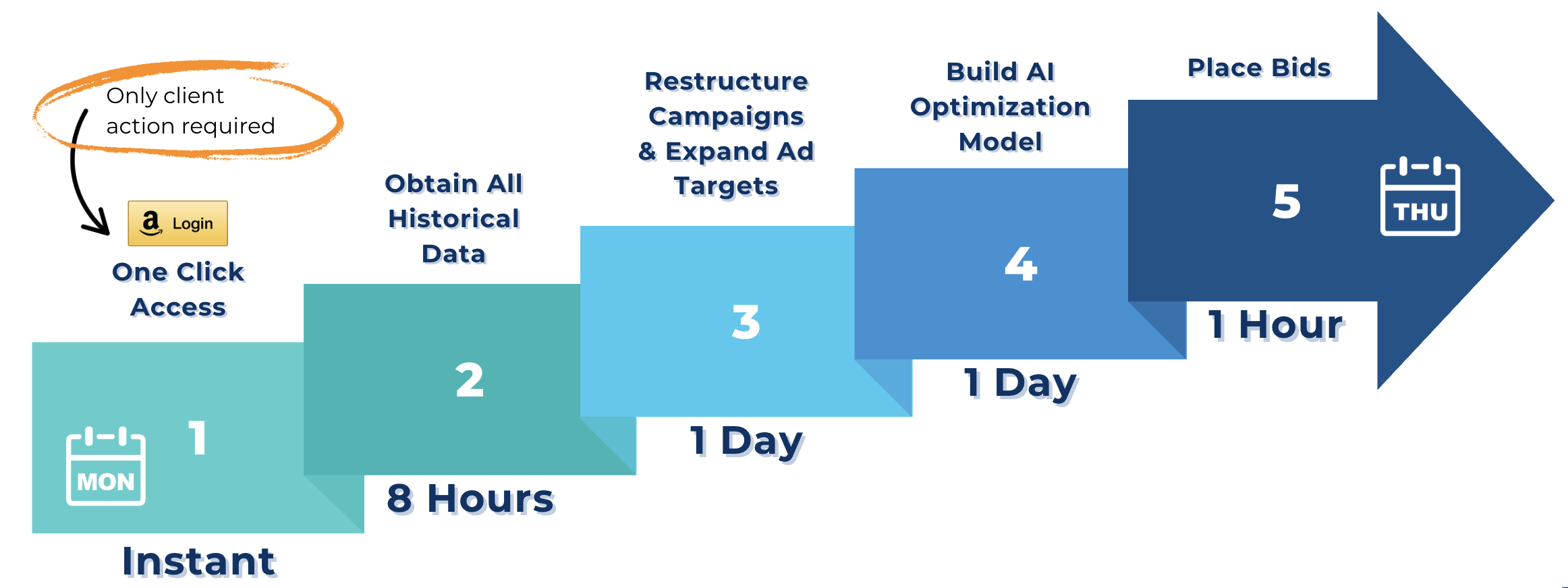
Capline onboarded this vast catalog in just 3 days, automating what would normally take an agency months.
Here’s how:
- Data In, Fast – Access to Amazon data was collected in hours.
- Smarter Campaign Structure – Campaigns were restructured, keywords expanded 25x, and targeting maximized.
- AI-Powered Bidding – Machine learning models optimized bids at the product level, factoring in costs and margins.
- Profit Focus – The system prioritized profitability over sales, driving growth toward higher-margin products automatically.
The Results: Profitability Unlocked
In just 3 weeks, Capline delivered transformational impact:
- 61% lower ad spend
- +17% increase in gross profit
- $2.1M annualized incremental profit
- ROAS more than doubled: 8x → 19x
Perhaps most impressively, Capline expanded ad coverage from 24% to 100% of sales and discovered $3.9M in incremental sales opportunities from ASINs with no prior ad history.
A marketing leader at the retailer summed it up:
“No other tool or agency has delivered results this dramatic. Capline truly sets a new standard.”

Why It Mattered
The breakthrough wasn’t spending more, it was spending smarter. By stripping away unprofitable ads and reallocating investment toward the right margins, products, and placements, Capline unlocked scalable growth that traditional tools couldn’t touch.
Takeaway for Retailers
If your Amazon ads feel inefficient—or capped by agency bandwidth—Capline proves there’s a better way. With AI-driven bidding and a profit-first mindset, retailers can win on Amazon not just with more sales, but with measurably stronger financial performance.
Interested in driving profitable Amazon growth? Let’s talk about how Capline can do the same for you.
Unlocking Smarter Growth: How Capline Outperformed a Top Amazon Ad Tool for a $700M Seller
How Capline helped a $700M seller gain control of their spend strategy to reignite growth
When you’re a $700M Amazon seller spending $20M a year on ads, the stakes are high. For this retailer, even with one of the leading bidding tools and a large in-house marketing team, performance had stalled. Costs were rising, and campaigns couldn’t adapt fast enough to changing business goals.
That’s when they chose Lighthouse.
The Situation: Growth Stalled Despite Heavy Investment
Despite their size and resources, this seller faced a familiar challenge:
- Flat Results – Ads weren’t scaling profitably, despite millions spent on a top bidding tool.
- Rigid Optimization – Tools struggled to adjust to shifting revenue vs. profit priorities.
- Complex Portfolio – Thousands of ASINs, many with little or no ad spend history, created untapped opportunity.
They needed a more data-science-driven approach—one that could continuously balance profit and growth.
The Capline Solution: Dynamic Financial Optimization
Within days of onboarding, Capline applied its Dynamic Financial Optimization framework:
- Automated Restructuring – Campaigns were rebuilt for keyword-level bidding, tuned to each individual ASIN.
- Granular Modeling – Lighthouse measured spend elasticity and conversion rates at the ASIN-Keyword-Placement-MatchType-Hour level, modeling profit and revenue trade-offs.
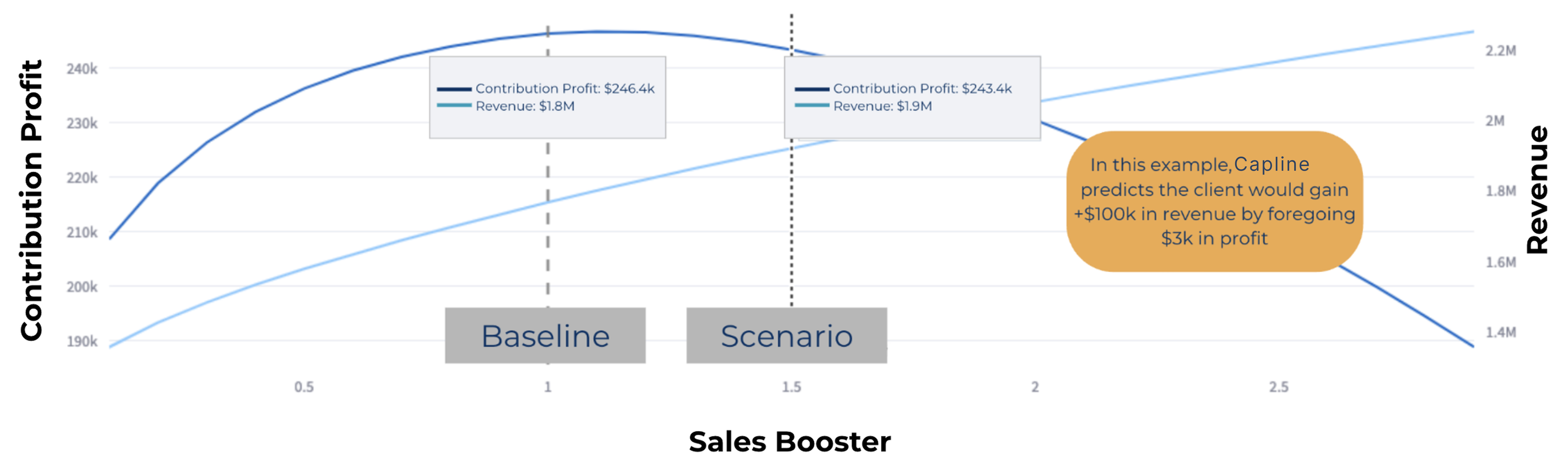
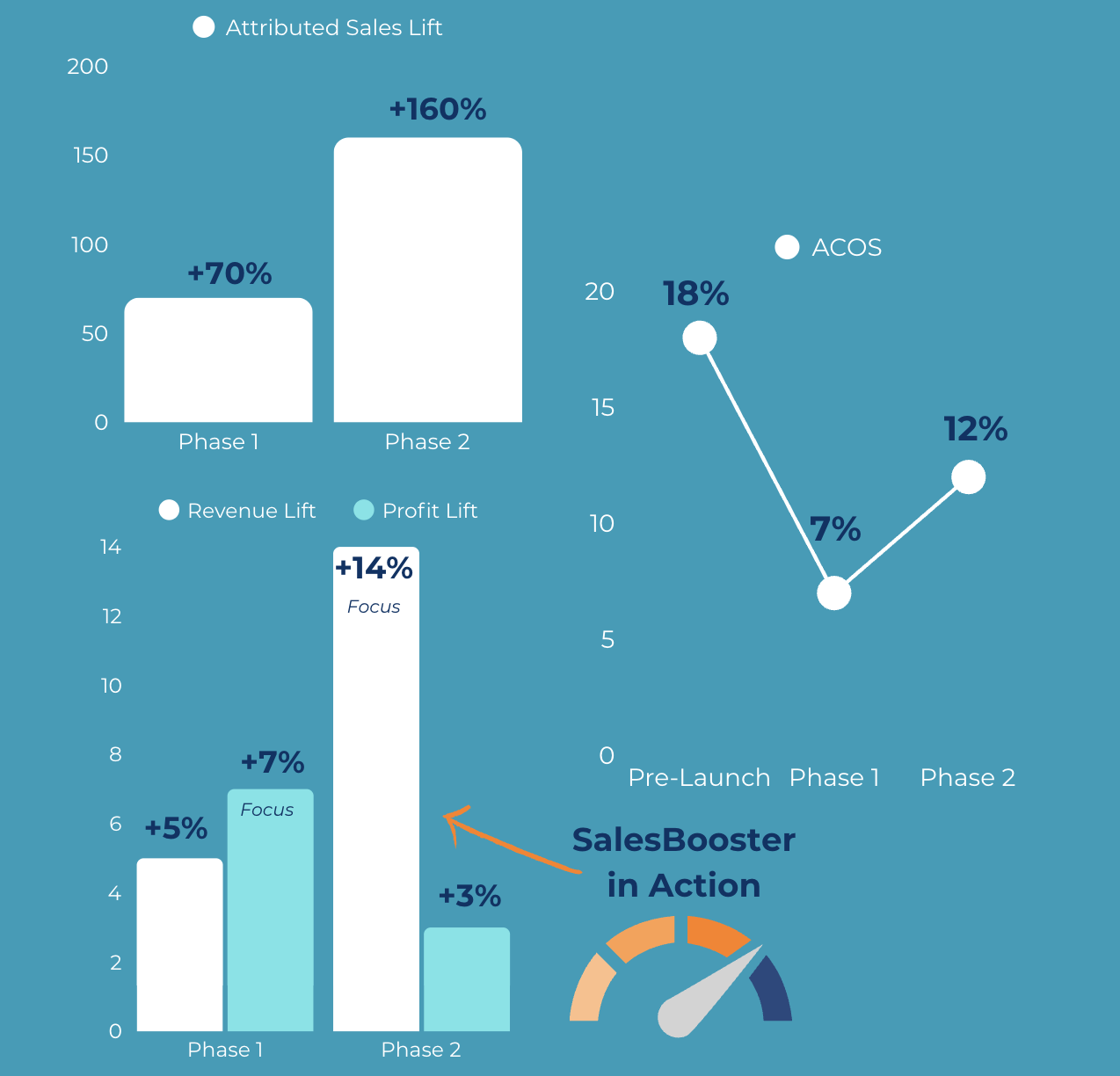
- Phased Rollout – We began by maximizing profit across the catalog (Phase 1), then shifted into revenue acceleration mode with Lighthouse SalesBooster (Phase 2).
- Statistical Rigor – Performance was validated through a balanced A/B test to confirm significant gains.
The Results: Profit First, Then Scaled Growth
Capline delivered transformational results in both phases:
Phase 1 – Profit Maximization
- 70% lift in attributed sales while lowering Ad Cost of Sales (ACoS) from 18% → 7%
- +7% profit lift at the portfolio level
- Prevented profit dilution by eliminating excessive bids
Phase 2 – Revenue Acceleration
- +160% lift in attributed sales
- +14% revenue lift overall
- Cold-start ASINs—previously untapped—generated +14% revenue and +5% profit at a highly efficient 7% ACoS
- Kept ACoS below pre-launch levels, despite higher sales volume
Why It Worked
Unlike traditional tools, our system:
- Models elasticity at the product level to find the true “profit vs. revenue” sweet spot
- Seamlessly shifts between financial objectives (profit vs. revenue acceleration)
- Adapts dynamically to new product launches, Buy Box competition, and market conditions
The result? More sales and more profit, with efficiency that scales.
Takeaway for Large Sellers
For high-volume sellers spending millions on Amazon, even small gains in efficiency translate into millions of dollars in profit. Traditional bidding tools plateau. Capline's profit-first approach breaks through the ceiling.
When performance stalls, the question isn’t how much you’re spending, it’s whether you’re spending it the right way.
👉 Ready to unlock smarter growth? Let Capline show you how.
Your Cost Data is Lying to You
If profit is king, cost data is the throne it sits on
Your cost data is lying to you
If profit is king, cost data is the throne it sits on
We know that brands put enormous effort into growing profit dollars - it's the primary way we work with them. Ad optimization. Price testing. Freight negotiations. Packaging redesigns to save a few cents a unit. The effort those same teams put into the cost data underneath all of it is usually close to zero.
Why, oh why is it so much easier to count the dollars coming in from each sale than the dollars going out? Every order confirmation tells you revenue to the penny. The cost side of that same sale is scattered: supplier invoices all in different systems, a freight bill, and a returns ledger. Lions and tigers and bears!
But obviously, every profit number you look at is downstream of your cost data. Contribution profit, margin by SKU, ad efficiency, even earnings: all of it starts from a data point about what each unit actually costs you. In our experience, that data point is wrong more often than it's right, and rarely in ways anyone notices, because nothing in the day-to-day operation of the business forces the question. Even at the best-run companies.
Meanwhile, a product you think earns a 30% margin actually earns 26%, or even 22%, and every price, ad bid, and reorder built on the 30% is wrong.
The number doing the work is marginal cost
Marginal costs are what it actually costs you to sell one more unit, freight and fees included. That's a different number from the catalog average or last year's standard cost.
Get it wrong in either direction and it costs you, but in different ways. Estimate marginal cost too high and you price above where you should, and you sit out ad auctions you could have won profitably. The volume goes to a competitor whose numbers are better, and nothing in your reporting ever shows you the sales you didn't make. Estimating it too low also comes with problems, your pricing floors stop protecting you, and your ad system happily buys volume that loses money on every unit while you celebrate growth.
Most of your competitors are running on averages and estimates. Precise marginal costs are one of the few advantages in ecommerce that's invisible from the outside and hard to copy, because it’s internal plumbing.
The five ways cost data goes wrong
No ownership. Ask who owns your revenue number and you'll get an answer in seconds. Ask who owns your cost table and you'll usually get a pause. Finance assumes ops maintains it, ops assumes it came from finance, and in practice it came from a file someone uploaded eighteen months ago.
Stale tables. Costs get loaded once, usually during onboarding or an annual planning cycle. Then suppliers reprice, freight rates move, packaging changes, and nobody touches the table. Six months later it describes a business that no longer exists.
Missing landed cost components. The unit cost on your supplier invoice is only part of the story. Inbound freight, duties, storage, and returns handling all belong in the number, and they rarely live in the same system. Most companies capture two or three of these and estimate the rest.
Adjustments that live in someone's head or spreadsheet. Rebates, volume discounts, co-op arrangements, that one negotiated deal from 2024. These get applied manually by the one person who knows the story. When the data moves to a new system, or that person moves to a new job, the adjustment goes with them.
Coverage gaps on the long tail. Costs exist for the hero SKUs everyone watches. The records go missing exactly where nobody is looking, on the back catalog and the slow movers, which is also where a bad default does the most damage because nobody catches it.
This matters more than it used to
Bad cost data used to be invisible because the decisions built on it were coarse, and that could mask a lot of noise.
Winning brand aren’t operating like this anymore. Ad bids are highly dynamic and get set against margin targets, and inventory buys get sized against contribution profit and in some cases prices are managed dynamically and continuously. When you are making thousands of small decisions a day with your cost data as an input, an error that used to produce a slightly wrong slide in a finance deck now loses you a little money on every one of those decisions, every day.
What it looks like when it's right
When one of our larger clients with tens of thousands of products started working with us, their cost picture was where most brands' is: "I think I have the major cost components." Confident on the invoice cost, less sure about everything layered on top of it, and no single number anyone would defend as the true cost of the next unit. And no way to keep it all updated and QAd. So we built them a cost service, that assembles the full landed cost per unit, ingesting each component from the system it lives in, and reloads it on a schedule so all updates are caught. It also QAs itself, flagging SKUs with no cost, costs that changed a suspicious amount, and nonsensical margins.
Getting to precise, per-unit marginal costs changed what the optimization on top could do. With accurate costs in place, the ad system could bid confidently into auctions that previously looked unprofitable on paper, and pull back where the old numbers had been flattering.
The work wasn’t particularly sexy, but the same optimizations got better because the numbers feeding them got more accurate.
Where to go from here
When we start working with a brand, cost data is one of the first things we ask for, and the process is the same one you can start on your own.
Start with a reconciliation. Take your current cost table and compare total implied COGS against what finance actually booked last quarter. If those two numbers are more than a couple points apart, you now know roughly how big your problem is, even before you know what's causing it.
Then check coverage. Count how many active SKUs have no cost record at all, and how much revenue they represent. A 5% SKU gap covering 1% of revenue is a cleanup task. A 5% gap covering 15% of revenue is a strategy problem.
Third, write down the components. List every cost element that should be in your landed number, then mark which ones are actually in the table, which live in a spreadsheet, and which live in someone's memory. The spreadsheet and memory columns are your risk register.
Finally, give it an owner and a cadence. Cost data doesn't need to be perfect, but it needs to be somebody's job, comprehensive, and kept fresh.
None of this is glamorous, but if profit is king, cost data is the throne it sits on. Before spending another dollar on optimization, it's worth checking whether the numbers underneath hold up.